2: Kinematics
3: Dynamics
4: Statics
8: Capacitance
10: DC Circuits
eg. Area is length squared.
Dimensional Analysis
The basic units of:
Mass (kg -- kilograms)
Length (m -- metres)
Time (s -- seconds)
Electric Current (A -- amperes)
Temperature (K -- kelvins)
Amount of Substance (mol -- moles)
Lumionous Intensity (cd -- candelas)
provide the basis for all other measurements.
eg. Speed is distance over time
eg. Force is mass multiplied by acceleration
In an equation, the dimensions must be the same on either side or the equation is incorrect.
eg. The equation for Kinetic Energy:
Vectors and Scalars
Vector quantities have both magnitude and direction. Scalar quantities have magnitude only.
Examples of Scalar quantities
Distance
Speed
Mass
Examples of Vector quantities
Displacement
Velocity
Force (weight)
Adding Coplanar vectors
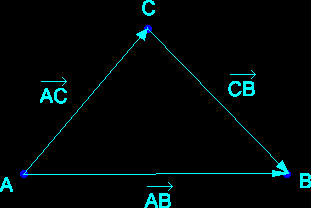
Imagine a man walking from point A to point C and then to point B. He would achieve the same result if he walked straight from point A to point B. Although the distance walked is different, the overall displacement is the same.
 is the sum of the vectors
  and
and  . This is shown as: + =
= - = + 
and
= -

The combined speed, as observed from the driver of one of the cars, is
= 60m/s - -50m/s
= 110 m/s
A car chasing another car.

The velocity of car A as seen from car B
= 60m/s - 50m/s = 10m/s
Resolving Vectors into Perpendicular Components
Vectors can be resolved into perpendicular components from geometry.
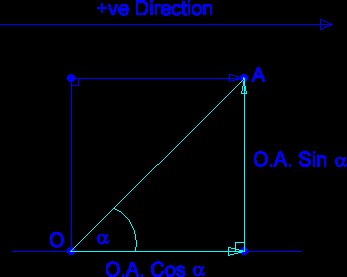
 =
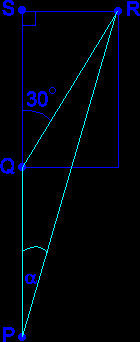
=  +
+ 