These are called isotopes.
Contents:
The Fundamental Particles
Mass and charge of subatomic particles
Matter is composed of tiny particles called atoms. The mass of an atom is concentrated in a tiny part of the atom called the nucleus. The nucleus is positively charged and consists of protons and neutrons. These particles are called nucleons. Negatively charged electrons occupy the surroudning space.
Particle |
Relative Charge |
Relative Mass |
Proton |
+1 |
1 |
Neutron |
0 |
1 |
Electron |
-1 |
0 (almost) |
The "12" stands for the Mass Number, that is, the number of nucleons (protons + nutrons),
and the "6" stands for the Atomic Number -- the number of protons.
Some atoms have different numbers of neutrons, giving rise to different mass numbers:
These are called isotopes.
Element |
# of Protons |
# of Neutrons |
# of Electrons |
|
19 |
20 |
19 |
|
13 |
14 |
13 |
|
92 |
143 |
92 |
|
92 |
146 |
92 |
|
38 |
49 |
38 |
Types of Radiation
Alpha (a) Helium nucleus
Beta (b) Electron
Gamma (g) Wave radiation
Effect of an Electromagnetic Field on Radiation
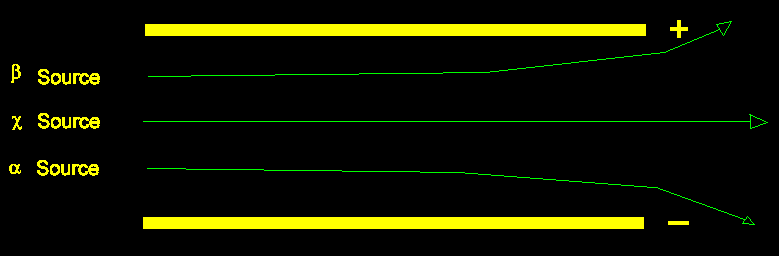
Beta radiation, the electron, can be stopped by 10mm of metal. High penetration power.
Gamma radiation, electromagnetic radiation, stopped by 10cm of metal. Very high penetration power.
Alpha Partical Emissions
Emission of particles is called radioactive decay. When an isotope releases an alpha particle, its atomic number decreases by 2 and its mass number decreases by 4 (the atomic and mass numbers of the helium nucleus).
eg.

eg.

Danger of Radioactivity
All three types of radiation are dangerous and can damage living cells. High doses of radiation will destroy cells. Exposure to low levels can damage the nucleus of the cell causing it to reproduce incorrectly. The new cells produced are different to the original ones and grow into a tumor. People working with radioactive materials are constantly monitored to ensure they are not exposed to more than permitted levels.
Half Life
The rate at which a radioactive isotope decays cannot be altered and is proportional to the number of atoms present.
The time taken for a number of radioactive atoms to decay to half that number is called the half life -- t(1/2).
The next number will then reduce again in the next half life period.
eg. Cobalt-60, t(1/2)= 5 years.
Time (years) |
Mass (grams) |
0 |
8 |
5 |
4 |
10 |
2 |
15 |
1 |
20 |
1/2 |
The mass will bever reach zero as the half life is inversley proportional to the rate of decay.
Uses of Radioactive Isotopes
1. To destroy cancerous tissue by exposing it to gamma radiation.
2. To sterilise surgical instruments.
3. Radio-dating using Carbon-14. Can be used to calculate the age of plant and animal remains.
4. Used in analysis by labeling a compound with a radioactive isotope and then calculating its concentration by measuring the rate of radioactive decay.
Electronic Structure
Ionisation Energy
The first ionisation energy of an element is the energy required to remove one electron from each of a mole of atoms in the gas phase to from a mole of cations in the gas phase.
From He to Li and from Ne to Na, the IE decreases sharply. This is because the single outer electron in Li and Na is much easier to remove than the Nobel gas electrons. From Li to Ne and from Na to Ar, the nuclear charge increases. It is more difficult to remove electrons.
Successive IEs
It is found that, to remove a second electron from an atom takes a lot more energy than the first IE due to the increased attraction on the remaining electrons. Removal of further electrons takes progressively more and more energy.
eg. Potassium has 19 electrons:
These shells can be considered as being made up of 'sub-shells' as follows:
First shell (energy level), n=1, can have two electrons in it.
Second shell, n=2, can have 2 electrons in one sub-shell and 6 electrons in a slightly higher sub-shell.
Third shell, n=3, can have 2 electrons in one sub-shell, 6 electrons in a slightly higher sub-shell, and 10 electrons in an even higher sub-shell.
Sub-shells containing 2 electrons are called 's' sub-shells. Those containing 6 electrons are called 'p' sub-shells, and those containing 10 electrons are called 'd' sub-shells.
Electrons always occupy the lowest available energy sub-level and, as soon as each sub-level is half filled, the electrons pair up.
The following notation is used to show the deatiled electronic structure of an atom.
eg. Potassium
Atomic Orbitals
It is difficult to plot the movement of an electron around a nucleus because of its high speed, so it is easier to imagine it as a negatively charged cloud. For most of the time, the 1s electron in Hydrogen stays a fixed distance from a nucleus but could be in any direction. This implies a shperically shaped charge cloud where the electron spends most of its time. These regions in which there is the greatest probability of finding a particular electron are called orbitals.
An electron can hold 1 or a maximum of 2 electrons. An 's' sub-shell is 1 orbital which is spherical in shape and a 'p' sub-shell consists of 3 orbitals which are approximately 'dumb-bell' in shape.
The number of electrons occupying each orbital in a particular atom can be shown using the "arrows in boxes" system.
eg.
1s |
2s |
2p |
3s |
3p |
|
| Carbon 1s22s22p2 |
  |
|
|
||
| Oxygen 1s22s22p4 |
|
|
|
eg. Group I
Li: 2,1
Na: 2,8,1
K: 2,8,8,1
All have one electron in the outermost shell. The postition of the electron in the Periodic Table is related to its electron structure. Using the Periodic Table, the detailed electronic structure of an atom can be determined.
eg. Phosphorus, P,
1s2 2s2 2p1 3s2 3p3
The electronic structure can sometimes be shortened by assuming the structure of the underlying shells which correspond to a Nobel gas.
eg. Vanadium, V,
[Ar] 4s2 3d3
where [Ar] = 1s2 2s2 2p6 3s2 3p6
Note: The Group number corresponds to the number of electrons in the outer shell. The period number corresponds to the number of main shells.
 Potassium
 Aluminium
 Uranium
 Uranium
 Strontium